Shahmaran: Reclaiming the Body, Memory, and What Survives
Shahmaran: Reclaiming the Body, Memory, and What Survives
Bodies are rarely allowed to simply exist. They are observed, disciplined, hidden, medicalized, judged, and often spoken for before we have the chance to speak for ourselves. From an early age, many of us inherit rules about how our bodies should behave, what they should conceal, and which parts of ourselves are acceptable to name, show, or understand. This workshop was created in response to that.
Inspired by Shahmaran, a figure rooted in Kurdish folklore, the session invited participants to reflect on the knowledge their bodies hold: shaped by memory, shame, transformation, protection, and survival. Shahmaran is often remembered as a figure of wisdom in herbs, medicine, and fertility. Associated with healing and embodied knowledge, yet her story is also one of betrayal. Her body becomes something others seek to access, control, and extract from. Across retellings, she reflects a familiar condition: the body interpreted and regulated by external systems, valued for what it can yield rather than what it is.
And yet her story does not end in extraction. It continues through transformation, through what remains. From this, the workshop centered a simple idea: what is held in the body does not disappear through shame or silence. It shifts form. It survives.
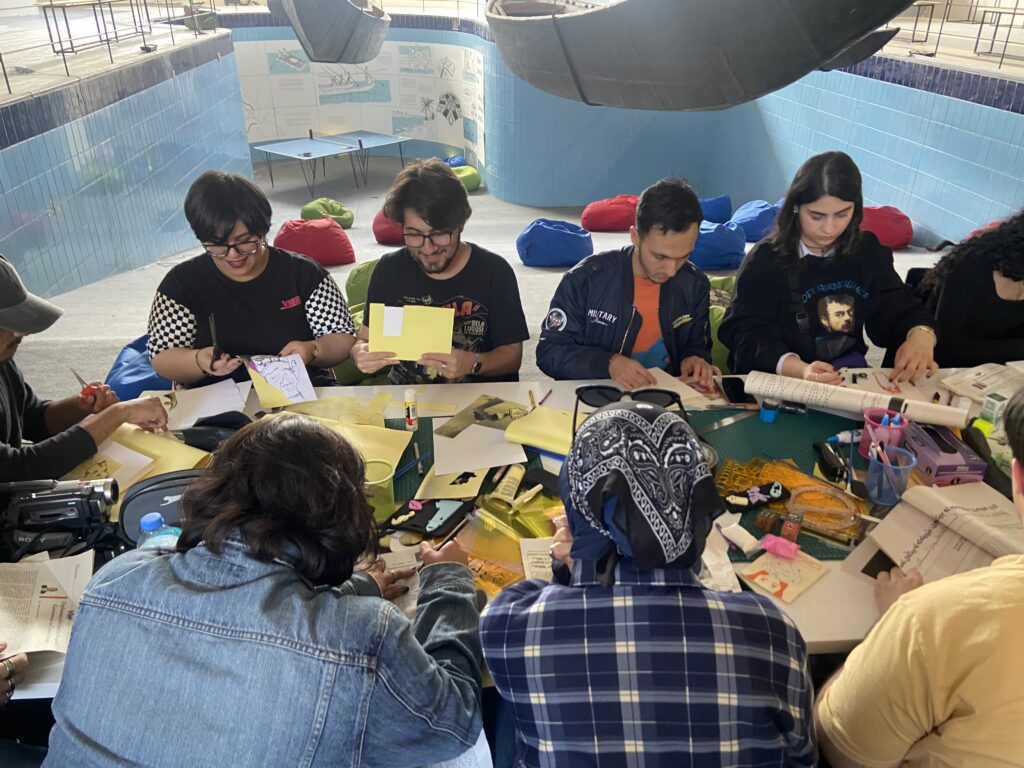
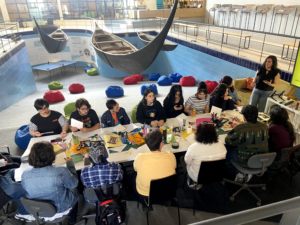
This was our first workshop in Sulaymaniyah, in the Kurdistan Region of Iraq. Many participants were art students at the University of Sulaymaniyah, alongside others from different fields. Before the workshop began, one participant arrived carrying a handmade artwork as a gift. A generous gesture that we kept at the venue as an early marker of care, presence, and our workshop.
The workshop was divided into four sections, each contributing to one page of a personal zine created by every participant.
Section One: The Body I Carry
We opened with an exercise centered on silhouette-making. Rather than providing a fixed body outline, we intentionally left the form open. Participants could create the silhouette of a person, a hand, a window, a door, or any shape that felt meaningful to them. They were then invited to reflect on a series of prompts:
What has your body carried? What has your body been told?
Responses were highly experimental, expressed not only through writing but through marks, color, texture, and abstraction. Participants translated anger, trauma, softness, and protection visually rather than literally.
Originally, these silhouettes were meant to function as interactive flaps or doors that opened to reveal hidden writing underneath. However, many participants created forms that were too large, too small, or too unconventional to function as intended. Rather than forcing the original structure, we adapted to their flow.
Participants continued building around their forms however they wished: writing over them, layering collage, embedding hidden messages, or creating frames using cut-out Kurdish and English newspaper text. The page became a response to one final question:
What would your body say if it could finally speak?
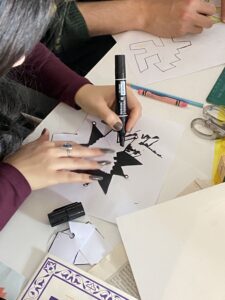
Some wrote in Kurdish, others in English, and some blended Kurdish written in Latin script.
Section Two: What Was Taken / What I Reclaim
The second section shifted from reflection to confrontation. Returning to Shahmaran’s story, we discussed extraction: how knowledge can be taken from a body, and how bodies themselves are often treated as sites to regulate, discipline, and define.
Participants were guided through a brief meditation on what had been taken from them and what they had been taught to hide.
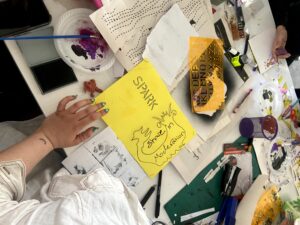
Several participants began sharing their reflections aloud. One participant described losing something less visible but deeply personal: their sense of connection to themselves, and their ability to feel grounded and comfortable inhabiting their own body. The conversation expanded from external and imposed shame into something more internal: estrangement, disconnection, and the subtle ways people are taught to distance themselves from their own bodies.
Participants then translated these reflections visually, dividing the page between what had been imposed or taken from them, and what they were reclaiming. Shame became pride, silence became expression, and disgust became embrace.
Participants were actively rewriting the language through which they had learned to understand themselves.
Section Three: Footsteps, Fingerprints
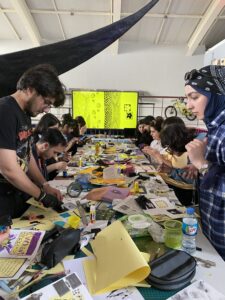
When we announced the coffee break, no one wanted to leave. Instead, participants remained in the room, continuing to work on their zines, discussing ideas, moving between materials, and experimenting with collage, markers, and texture.
This section introduced stamp-making and mark-making inspired by Shahmaran, the body, and the act of leaving traces behind.
Using soft clay, ink pads, and found objects, participants moved throughout the venue collecting impressions from surfaces, textures, and objects that resonated with them, searching for materials that resembled scales, veins, or resilience. Some used their shoes to create footprints and repeated marks suggestive of prints and traces left behind. Others collected impressions from flowers, textured ground, and tree logs.
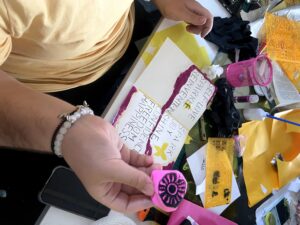
One participant discovered a metal mesh object and used it to create repeating patterns resembling snake skin, an intuitive visual reference to Shahmaran’s body.
Another used a childhood necklace they happened to be wearing, incorporating a personal object into the archive of marks they were building.
Section Four: Regeneration
Returning to the ending of Shahmaran, we reflected on continuation, transformation, and what survives. Participants were asked to consider what part of themselves remains no matter what, what they are passing on, and what they might want to tell younger versions of themselves. They were then invited to express this through writing, drawing, poetry, or stamps.
Several participants drew from Kurdish visual traditions, incorporating motifs inspired by Kurdish tattoos and patterns into their final pages. One participant chose to use the snake skin texture across her entire page. For her, the repeated marks represented shedding: the body leaving behind old layers and regenerating itself.
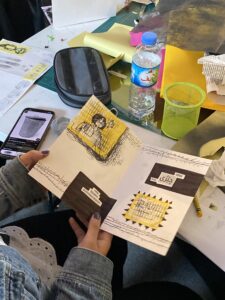
By the end, the workshop outputs felt less like zines and more like archives. Each page carried traces of something larger: imposed narratives, bodily memory, resistance, and transformation. During the closing circle, participants were invited to share a word, image, or sentence from their zine, or simply hold up a page they felt connected to. Many were eager to walk us through their work, explaining their creative decisions, the emotions embedded in each page, and what they had managed to express through the exercises.
Like Shahmaran, these stories do not end where they are interrupted. They continue in other forms, carried forward through what survives.
Follow us on Instagram → https://instagram.com/iraqizine
Browse the zines → https://iraqizine.com/zines